Modular Analog Synthesizer
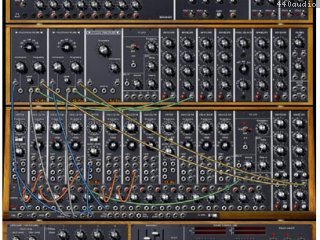
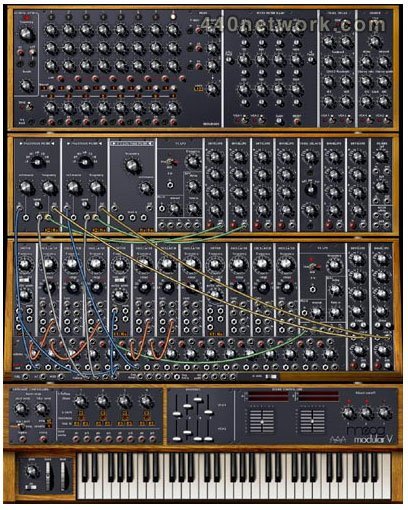
Moog Modular V, is a faithful representation of one of the modular analog synthesizers best known and loved by musicians since the end of the 60's.
The closest possible emulation of the characteristics of this legendary modular synthesizer was made possible by a new technology developed by Arturia, baptized TAE.
Robert Moog himself, who we have very early associated with the design and tests, claims to be convinced by the quality of the virtual synthesizer Moog Modular V.
 |
Version 2.6.0 |
MacOS X UB |
(App, AU, RTAS, VST) |
Nov 22, 2011 |
MIDI Control Assignment Improvement
Support for 64-bit VST and Audio Unit
Support for Pro Tools 9 & 10
Support for Mac OSX 10.7 (Lion)
 |
Version 2.5 |
MacOS X UB |
(App, AU, RTAS, VST) |
Oct 5, 2009 |
Sound quality inprovement:
* VCF audio quality improvements.
* better Audio Unit compatibility (Digital Performer most notably).
Performence inprovement:
* ability to use NRPN midi messages for automation.
* better handling of control surfaces while changing preset.
* midi RPN "pitch bend range" message is now recognized.
New ergonomics:
* One unique scrollable view to overlook the entire synth.
* Some of the modules are now interchangeable, allowing to configure - to a certain extent - the Modular the desired way.
New audio possibilities:
* Improvements on the oscillators (new free running), on the filters (better response to modulations), on the envelopes (faster and even closer to true analogical behaviour).
* New Unison mode
* New Audio-In possibilities
* The Soft-clipping emulation is now done on each mixer and not systematically on all of them, which saves on CPU load.
New modules
* 1630 Bode Frequency Shifter. Developed under the Moog license by Harold Bode in 1964, it is extremely rare (a dozen Worldwide).
* 928 Sample and hold is also very rare. Originally assembled in a separate cabinet, it was adapted on the last modular series, in the late 70's.
* 912 Envelope follower (or Schmit Trigger). One of the most popular modules on the Moog systems, it was often added to original configuration to create complex modulation through the use of an output signal.
* 12 stage phaser. The Moog 12 Stage Phaser was very well known, and originally conceived as an external rack to the Modular systems.
* Formant Filter. A new module developed by Arturia, which did not exist on the original Moog systems. It allows the filtering of sounds according to the formants a, e, i, o, u.
* Ring Modulator. Also a new module developed by Arturia, it creates very metallic sounds.
New presets
* 200 new presets to provide optimal use of the new modules.
 |
Version 2.2 |
MacOS X UB |
(App, AU, RTAS, VST) |
Dec 21, 2006 |
Universal Binary support
Vst 2.4 \ Cubase 4 ready
A new installer, regrouping all previous updates
 |
Version 2.0 |
MacOS X PPC |
(App, AU, RTAS, VST) |
Aug 25, 2004 |
New ergonomics:
- One unique scrollable view to overlook the entire synth.
- Some of the modules are now interchangeable, allowing to configure - to a certain extent - the Modular the desired way.
New audio possibilities:
- Improvements on the oscillators (new free running), on the filters (better response to modulations), on the envelopes (faster and even closer to true analogical behaviour).
- New Unison mode
- New Audio-In possibilities
- The Soft-clipping emulation is now done on each mixer and not systematically on all of them, which saves on CPU load.
New modules
- 1630 Bode Frequency Shifter. Developed under the Moog license by Harold Bode in 1964, it is extremely rare (a dozen Worldwide).
- 928 Sample and hold is also very rare. Originally assembled in a separate cabinet, it was adapted on the last modular series, in the late 70's.
- 912 Envelope follower (or Schmit Trigger). One of the most popular modules on the Moog systems, it was often added to original configuration to create complex modulation through the use of an output signal.
- 12 stage phaser. The Moog 12 Stage Phaser was very well known, and originally conceived as an external rack to the Modular systems.
- Formant Filter. A new module developed by Arturia, which did not exist on the original Moog systems. It allows the filtering of sounds according to the formants a, e, i, o, u.
- Ring Modulator. Also a new module developed by Arturia, it creates very metallic sounds.
New presets
- 200 new presets to provide optimal use of the new modules.
 |
Version 2.0 |
MacOS 9 |
(MAS, RTAS, VST) |
Aug 25, 2004 |
New ergonomics:
- One unique scrollable view to overlook the entire synth.
- Some of the modules are now interchangeable, allowing to configure - to a certain extent - the Modular the desired way.
New audio possibilities:
- Improvements on the oscillators (new free running), on the filters (better response to modulations), on the envelopes (faster and even closer to true analogical behaviour).
- New Unison mode
- New Audio-In possibilities
- The Soft-clipping emulation is now done on each mixer and not systematically on all of them, which saves on CPU load.
New modules
- 1630 Bode Frequency Shifter. Developed under the Moog license by Harold Bode in 1964, it is extremely rare (a dozen Worldwide).
- 928 Sample and hold is also very rare. Originally assembled in a separate cabinet, it was adapted on the last modular series, in the late 70's.
- 912 Envelope follower (or Schmit Trigger). One of the most popular modules on the Moog systems, it was often added to original configuration to create complex modulation through the use of an output signal.
- 12 stage phaser. The Moog 12 Stage Phaser was very well known, and originally conceived as an external rack to the Modular systems.
- Formant Filter. A new module developed by Arturia, which did not exist on the original Moog systems. It allows the filtering of sounds according to the formants a, e, i, o, u.
- Ring Modulator. Also a new module developed by Arturia, it creates very metallic sounds.
New presets
- 200 new presets to provide optimal use of the new modules.